Last week’s article examined the importance of accessibility features facilitating AEO and GEO to make your website visible. Increasingly, people are finding answers through AI-powered systems: Google’s AI Overviews, featured snippets, and generative tools like ChatGPT and Gemini. Accessibility doesn’t just help users – it also unscrambles content for machines.
(Read last weeks article here: https://littleforest.co.uk/aeo-geo-accessibility-how-to-optimise-your-website-for-the-ai-era/ )
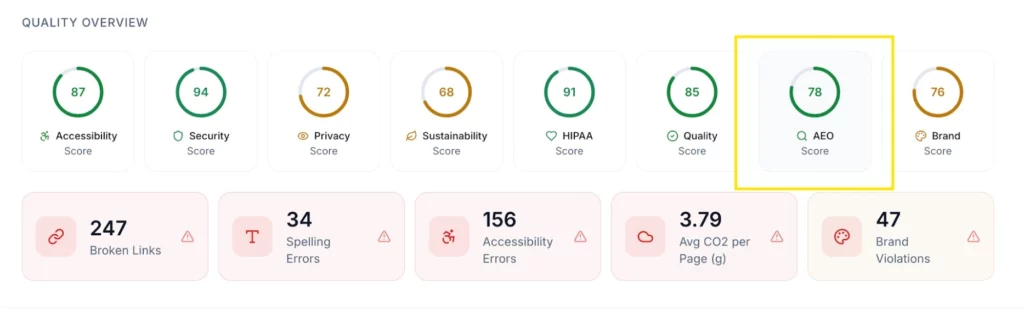
To help organisations understand how their content performs in this new landscape, we’re introducing a new crawler capability: GEO + AEO Scores.
This feature is designed to evaluate how well individual web pages are set up to appear in local search results, rich answers, and AI-generated summaries; truly highlighting clear, actionable opportunities for improvement. You can think of it a bit like Scrabble for search and AI – every page already has the letters it needs, but how those letters are arranged determines whether they form high-scoring words or just sit unused on the rack.
What Is GEO + AEO Analysis?
GEO + AEO analysis looks beyond traditional SEO signals and focuses on how search engines and AI systems interpret, summarise, and surface your content, particularly for geographically relevant queries and answer-based results.
Rather than asking “Where does this page rank?”, this feature asks:
- Is this page easy for AI to understand?
- Does it contain clear, answer-ready content?
- Does it signal local relevance where appropriate?
- Is it structured in a way that supports featured snippets and AI summaries?
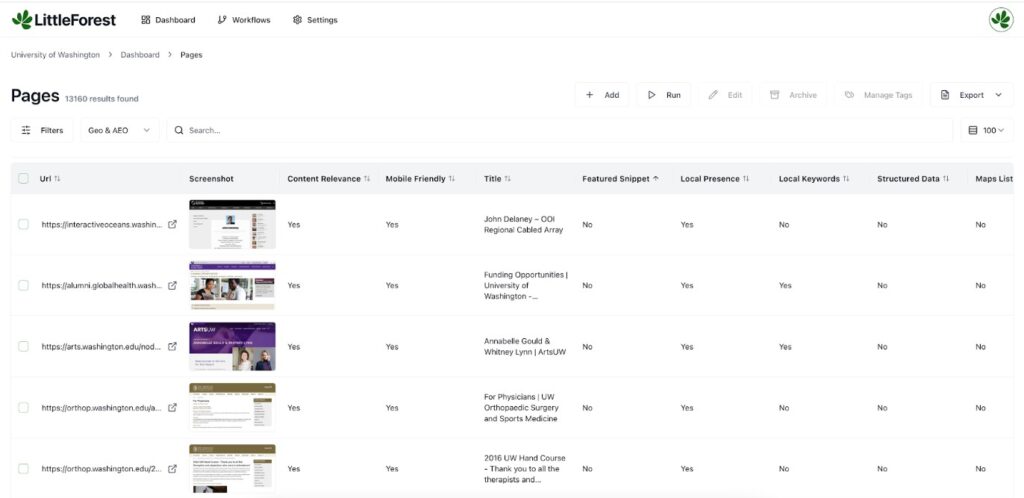
The crawler runs this analysis automatically on each page and produces a clear breakdown of strengths, gaps, and an overall score. In Scrabble terms, this is the difference between having the right letters and actually forming a valid, high-value word. The crawler analyses how well your page “plays” its content (not just what pieces it contains).

GEO + AEO Report Scoring System
The scoring system assigns a weighted score out of 100 based on eight key metrics that reflect a page’s performance for local SEO and answer engine optimization (AEO). Each metric has a predefined weight representing its relative importance. Missing a metric reduces the total score.
Metrics and Weights (Example)
| Metric | Weight | Description of what the Crawler Evaluates |
| Local Presence | 10 | Checks for clear indicators such as address details, phone numbers, city names, or “near me” language that help establish geographic relevance. |
| Entity Confidence | 10 | Detects consistency in address and organisation name. Alongside SameAs Schema, Footer Map consistency and internal links to location hub pages. |
| Structured Data | 20 | Looks for JSON-LD schema types, commonly used by search engines and AI systems, including: FAQPage, HowTo, QAPage, LocalBusiness, or WebSite. |
| Featured Snippet | 25 | Evaluates whether the page structure supports rich answers, such as: Clear question-style headings and concise, descriptive opening paragraphs (suitable for snippets). |
| Local Keywords | 10 | Identifies mentions of relevant city, country, or regional terms that help contextualise the page. |
| Content Relevance | 15 | Page provides structured, useful content formats (like FAQ sections, steps, definitions) to be easily summarised by AI systems. |
| Mobile Friendly | 5 | Confirms the presence of responsive design signals, such as a viewport meta tag. for mobile devices. |
| Page Speed | 5 | Measures load time, flagging pages that load in under three seconds as fast. |
Together, these signals determine whether your content spells something meaningful to AI or whether it appears as a jumble of letters that never quite form a usable answer.
How the Score is Calculated
- Start with a perfect score: 100.
- For each metric that fails (returns false/no), subtract its weight from the total score.
- Ensure the final score is never negative; the minimum is 0.
Example Calculation
Suppose a page has the following metric results:
- Local Presence: ✅
- Entity Confidence: ❌
- Structured Data: ✅
- Featured Snippet: ✅
- Local Keywords: ✅
- Content Relevance: ❌
- Mobile Friendly: ✅
- Page Speed: ✅
Score Calculation:
Start: 100
Entity condfidence missing: 100 – 10 = 90
Content Relevance missing: 90 – 15 = 75
Final Score: 75/100
Much like Scrabble, not all tiles are worth the same. A page can include lots of content, but missing a few high-value “letters” (like structured data or snippet-ready content) dramatically lowers the final score.

Adjustable Scoring for Your Needs
Each page receives a weighted score out of 100, designed to give a quick, meaningful snapshot of AEO and GEO readiness.
Each missing or failing metric subtracts its assigned weight which is adjustable by the user for their specific needs or relevant factors.
Metrics like Featured Snippet and Structured Data reduce the score more drastically because they significantly impact AEO.
Lower-weight factors like mobile friendliness and page speed still contribute, but reflect their supporting role to overall quality.The result is a quantitative overview of the page’s local and answer engine optimization effectiveness that’s easy to interpret and easy to act on – whether you’re reviewing a single page or auditing hundreds at scale.

What This Feature Is Useful For
The GEO + AEO crawler analysis helps teams:
- Audit local SEO readiness beyond traditional keyword checks
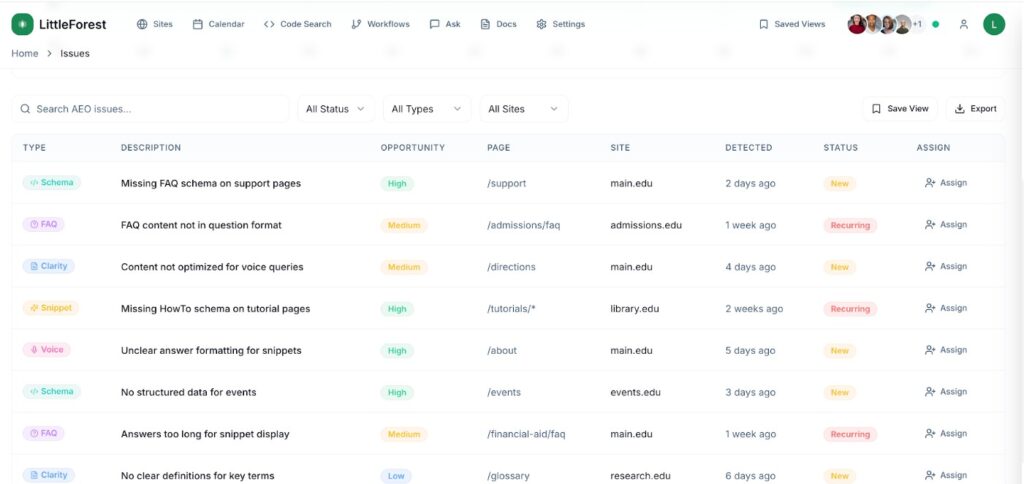
- Understand why pages may (or may not) appear in featured snippets or AI answers
- Identify missing structured data and answer-friendly content
- Prioritise fixes that improve both user experience and AI visibility
- Prepare content for an AI-first search environment
This is especially valuable for organisations with large, decentralised web estates; including universities, public sector bodies, and multi-location organisations – where consistency and clarity are essential.
Why This Matters Now – Unscrambling
As search behaviour changes, visibility increasingly depends on whether AI systems can understand, trust, and reuse your content.
Pages that are clearly structured, locally relevant, fast, mobile-friendly, and rich in structured data are far more likely to be:
✅ Summarised in AI Overviews
✅ Pulled into featured snippets
✅ Referenced by generative tools
This new crawler feature gives teams a practical way to measure and improve that readiness using real signals, not guesswork.
A Clearer Picture of AI Readiness
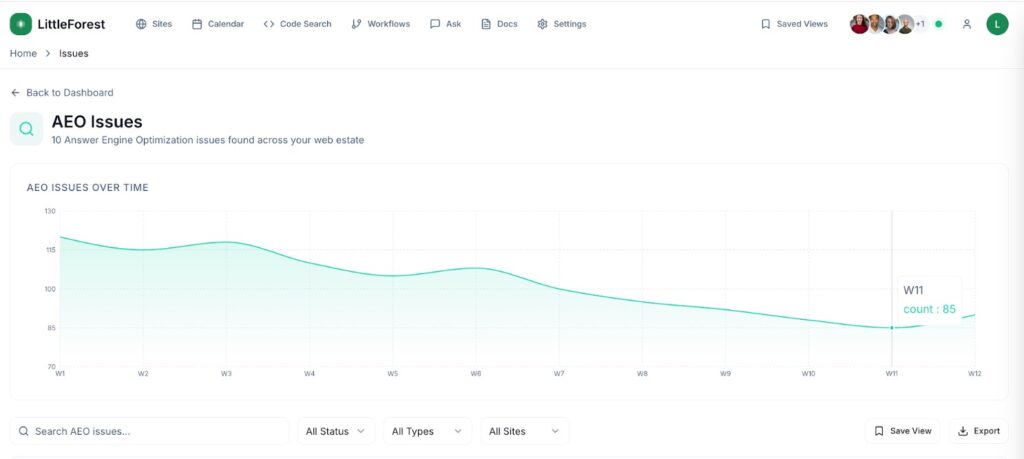
GEO + AEO Analysis builds on Little Forest’s existing crawling capabilities, adding another layer of insight into how your content performs in modern search and AI systems.
By combining automated evaluation, clear scoring, and actionable signals, it helps organisations move from awareness to action and ensures their content isn’t just present on the board, but placed where it can score – staying visible, relevant, and useful as search continues to evolve.
📩 Want to unscramble your AEO and GEO across your web estate and see where you stand? Get in touch via [email protected], we’d love to help you explore the new feature and what it reveals.